
Column: Fluttering, hopping bird on the ground is normal in spring. It could be a fledgling
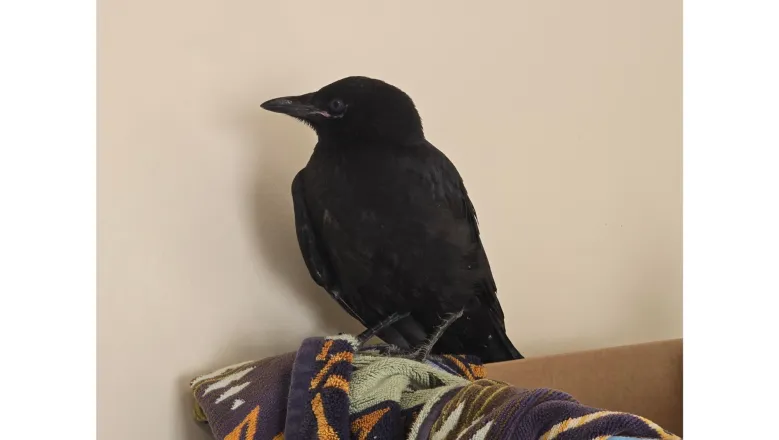
An injured fledgling crow at Pasadena Humane’s Sandra J. Goodspeed Wildlife Center.
A few years ago, my senior dog Sheldon alerted me to something unusual in our backyard. He had found a young crow hopping on the ground.
From a distance, I watched the bird. It didn’t try to fly, and my mind went to the worst-case scenario.
I assumed it must be injured, maybe a broken wing or something else preventing it from taking off. Wanting to help, I started gathering supplies: a cardboard box, a small dish of water, and gloves so I could safely pick it up and bring it in.
Before stepping in, I paused and reached out to someone who knows far more than I do. I contacted Lauren Hamlett, our director of Wildlife Education and Services, and sent photos to our Wildlife Helpline. Our team asked a few triage questions about the bird’s condition, what I was seeing, how it was moving and whether there were visible injuries.
The response surprised me. The young crow wasn’t injured at all. It was healthy and behaving exactly as it should.
What I had found was a fledgling.
As Lauren explains, fledglings are young birds that have developed their feathers and are learning to fly. It’s normal for them to spend a week or two on the ground, hopping, fluttering and learning to forage.
They can look clumsy. Sometimes their feathers appear uneven or scraggly as they continue to grow. But this stage, awkward as it may seem, is a critical part of their development.
Just as important, fledglings are not alone. Even when we don’t see them, their parents are usually nearby, watching closely and continuing to feed and protect them.
This is very different from a nestling. Nestlings are much younger birds that should still be in the nest. They are often featherless or downy, sometimes with their eyes still closed. If a nestling is found on the ground, it likely does need help.
Standing in my backyard that day, I realized how easy it would have been to make the wrong call. If I had scooped up that crow and brought it to Pasadena Humane, I would have interrupted an essential developmental period the bird needed to survive in the wild.
Now, if I see a fully feathered young bird on the ground, I know I shouldn’t rush in. It’s best to first look for signs of adult birds nearby, flying overhead or keeping watch. Then give the situation some time by observing from a distance for a few hours or even setting up a camera to monitor without being present.
While Sheldon alerted me to the fledgling, it’s best to keep pets indoors to prevent them from interfering with the bird. And while it may feel helpful, Lauren advises against leaving food or water for fledglings.
Spring is our busiest season for wildlife calls, and most of the fledgling reports we receive turn out to be healthy birds at the exact same stage as my crow. Knowing the difference between a bird that needs help and one that doesn’t is one of the most valuable things we can learn.
To support our community, we’ve created a pocket-sized fledgling field guide featuring common Los Angeles County bird species, along with a simple flowchart to help determine whether a baby bird truly needs help. It’s something you can keep in a bag, a glove compartment, or share at a school or nature center.
You can pick one up at any of our upcoming wildlife events, including our Mindful Wildlife Walk and Talk this Sunday, May 3, at Hahamongna Watershed Park.
If you need help with a baby bird, contact our Wildlife Helpline at 626-344-1129 or visit pasadenahumane.org/wildlife for more resources.
Chris Ramon is president and CEO of Pasadena Humane.
This blog post originally appeared as a column in the Pasadena Star-News on May 1, 2026.